
Why Joy at Work?
Through our research, we've discovered that joy (in the work context) drives better results, both in everyday tasks and times of crisis.
Welcome to the Research
We're investigating this hypothesis:
Joy at Work is a measurable state of being (for both an individual and an organization) that indicates to what extent the culture of an organization contributes to its success.
Our approach is to interview senior leaders at for-profit companies, non-profits, and government agencies of all sizes and apply Grounded Theory to understand the relationship across the already identified 10 Dimensions of Joy at Work.
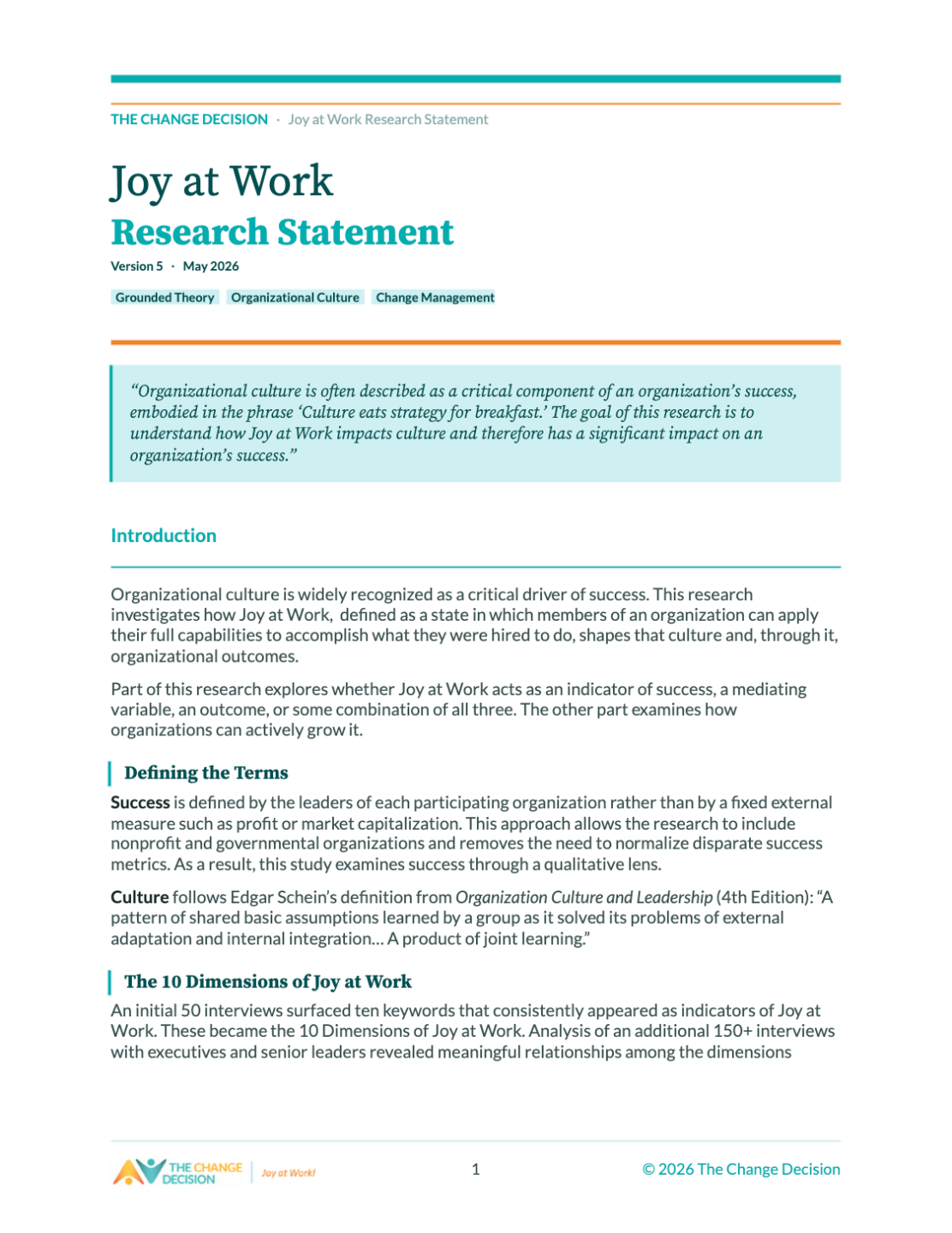
You're welcome to take a look at our Joy Research Statement.
Get the latest Research Results
New joy resources and the results of our latest Joy Research delivered to your inbox:
Sign up for Joyful Change BrainThe Case for Joy at Work
Is it worth creating a joyful workforce? Take a look at this video to see why we think it is, and see the roles that are accountable for creating joy in the workplace.
Joy in the workplace is about the struggle
When we say the word joy, many think we mean fun. That's not what people tell us it is.
Joy in the work context is about applying your skills, experience, and personality to the hard problem you were hired to solve. Even better when you're working with people doing the same. Even better when you're growing and when mutual respect increases as you work together. This is what the research tells us joy is in the context of work.
Fun is secondary. Fun is Joy at Work when it's a throw-off of the struggle.
The connection to change: Most view change as something to get through. If change is constant, if it's normal, just getting through it is an irrelevant strategy. It's a constant push downward that works against the time and money you spend to hire, develop, evaluate, and engage your team. The goal is to be great at the struggle, the Joy at Work. Moving away from creating transactional "what's in it for me" expectations, and toward "this is why we're here!" inspiration.
From Imagination to Impact
Click the video to learn about the 10 Dimensions of Joy at Work and how to use them in your Change work.
Even the most difficult change can be done in a way that is respectful of everyone involved, including those directly impacted, decision-makers, the company, and their customers. With this idea in mind, we can see the potential for reframing change toward an upward spiral for the organization and the people involved.
Our Change & Joy Model (see above) illustrates this simple idea that how change is introduced and handled will impact the organization’s Joy at Work, which from our research, we see as the dimensions on the right. At the same time, the amount of Joy at Work already present in the organization will impact how well the change will go and whether the value of making the change is ultimately achieved.
Rather than thinking, “how can we get through this change with the least impact on productivity as possible,” you can ask, “how can we change our ways of working and increase our joy in the process”.
The first is a rational business question but misses the traction you get through people by asking the second. Even the most mundane business changes framed this way have the potential to uplift the organization.
Guide to Joy at Work ebook
Get a detailed view into the dimensions of Joy at Work revealed in 10 years of research done to understand what experiencing joy in the workplace means to leaders and employees.
Learn how the dimensions contribute to joy in the workplace and how to recognize the signs they're working well (or not) in a company. See where you already have strengths and where you can focus. Practical tools are included so you can apply the Joy at Work Dimensions to your life at work, both individually and company-wide.
eReader Format
Areas We're Currently Studying in Academic Literature
Positive Psychology
The role of positive and negative emotions on humans, individually and in groups
Upward spiral concept
Decision-making and the role of broad or narrow mindsets
Organizational Change
The role of joy in organizational change
Employee agility and resilience and its affect on organizational change
Occupational Health
Leader mental health
The cost of leading an organization under stress on leaders
The impact on leaders knowing they are harming employees
Work Philosophies
The intrinsic pleasure of work
Meaningful work
Evolving expectations of work for the employer and employee
Contribute to the Joy Research
After completing this survey you'll receive an email confirming your response has been submitted with a link to view your responses.
Click the video for an introduction from Ed and Roxanne!
